
“It is hard to be brave, when you’re only a very small animal.”
Winnie-the-Pooh
What I’ve realised over the last couple of weeks
I’m feeling pretty damn proud of myself for the last fortnight. This is one of those times in Deliberate Practice where I have a sense of accomplishment on the back of my most recent efforts. I know DP does not feel like this always and that it would be a fruitless battle to aim for that, but I’m happy to enjoy this feeling of pride while it hangs around. The source of my pride comes from three things that have happened – these will be what I talk about in this post. To start, I managed to have have my first session of solitary DP. Second, I built up the courage to start the Session Rating Scale debrief with clients at 10-minutes left in a session, where before it would be at 5-minutes left. Third, I have slightly expanded on how I discuss means (working on symptoms) vs goals (life improvement) with clients, after laying out some initial ideas in a previous post.
I have noticed how it can be quite challenging to maintain progress across two stretch goals at once, now that I’ve moved to goal-setting, after my first stretch goal was on gaining actionable feedback from clients. I picked up that I had started using person-centred words in my questions again with clients when discussing their SRS scores, I think this was in part due to feeling increasingly rushed to finish sessions. When I got tired of this being a consistent issue I decided to turn to my taxonomy of deliberate practice. I reviewed my first stretch goal to allow myself to start the SRS discussion earlier into the session; all this has reminded me that it’s important to review my taxonomy regularly:

What I’ve managed to do since my last post
In my previous post I spoke about how I would use solitary DP to work on goal setting with clients. Since then I have had the opportunity to test that plan. I had my first session of solitary DP last Friday and used LOVO to act as the client. It had taken me 14 minutes in total to complete four rounds of solitary DP, where in each round I practiced my introduction to goal-setting with an AI client named “Oliver”. I based his responses off what a real client had said in a previous session through the week. My nerves were definitely highest in the first round – as my wording was clunky, awkward and I was starting sentences with no end in sight. Oliver was very understanding though. I used the solitary DP worksheet to rate my reaction with each practice round. I felt my tension levels gradually reduce which each round; as I rated the difficulty of the exercise as an 8/10 in the first round, which reduced to 5/10 by the 4th round. I didn’t add any additional principles to my practice throughout the rounds, as I wanted to keep things simple and my focus on the steps I had set out for myself. I then reflected on the session by filling out the DP reflection form.
Below is an example of what LOVO looks like in action:
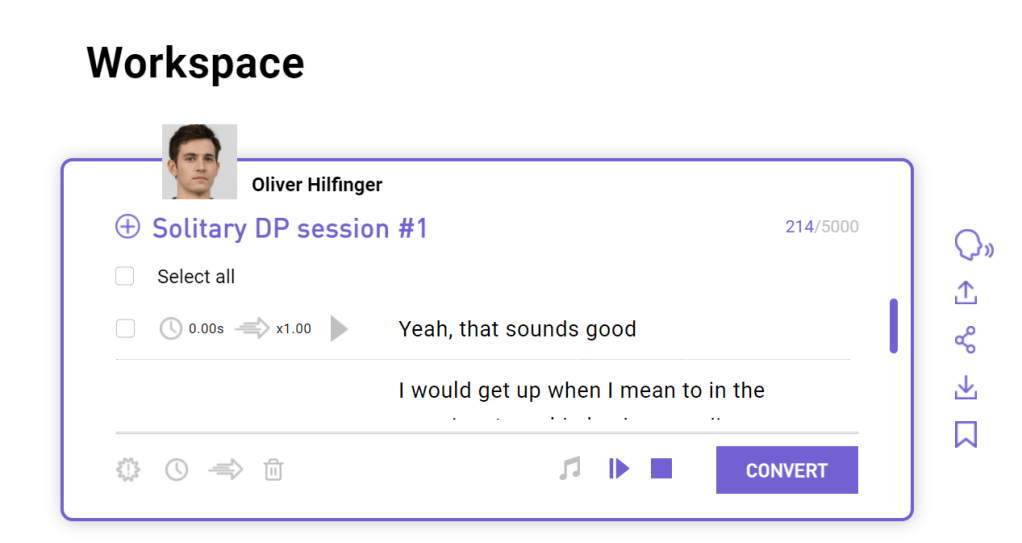
I have since taken the same steps practiced in solitary DP and run through them with real clients. Again with the aim of encouraging client’s to think about how they will be behaving differently if the therapy works – then using what they come up with as the goals for our therapy. This has helped me perform what I have been practicing in the solitary DP. I haven’t checked -so take this with a grain of salt- but I think this has resulted in higher SRS scores on goals and topics compared to what I would get in the past.
In my next session of solitary DP I will keep my steps and approach largely the same. As last time I was concentrating on the steps I had laid out to practice, next time I will see if I get up to taking it a step further by focusing on an additional principle, such as really emphasising the client’s words with my tone of voice. If this goes well I’m thinking of adding some improvisation as an additional step in the practice. I imagine I’ll be staying on these ideas for a few sessions at least, as it surprised me how quickly the first session went and I do want to focus on pacing myself.
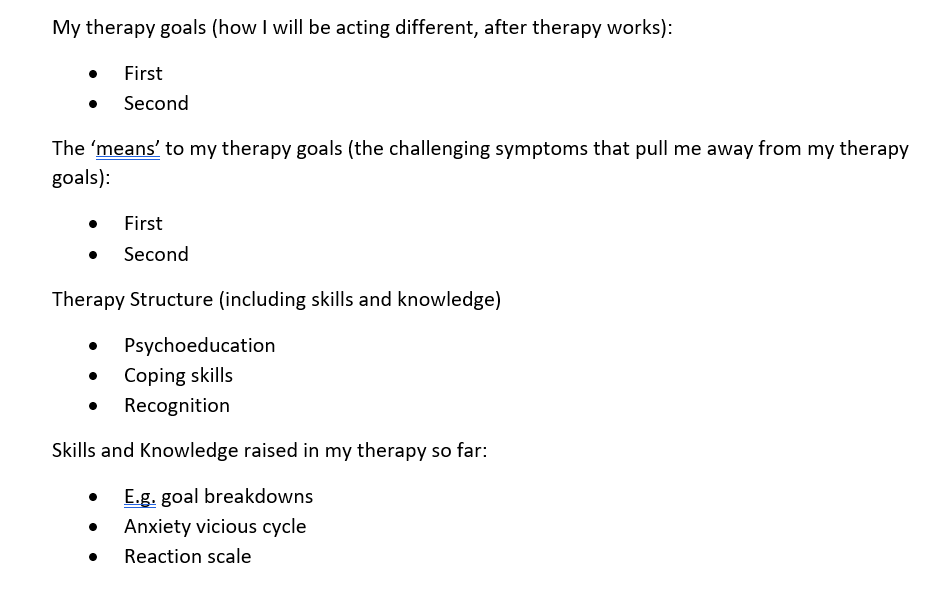
This takes me to the second change I introduced – I decided to see if I could take the discussion on a client’s goals and write them into a word document during the session. This was with idea that client’s could have in one place their therapy goals, means goals, a reminder of the three pillars of therapy and a place to track what skills and knowledge had been covered in therapy so far. As seen below:
“Success is not final, failure is not fatal, it is the courage to continue that counts.”
Winston Churchill
In the never-ending search for what works
I very often think about how I can make what I do work better. Seeking out what works tends to involve trying new things and getting out of my comfort zone – which can be scary. It’s easy for that fear to result in deciding to keep things the same, even if what I’m doing does not work as much as I would like. Which takes me to the third change I managed over the last fortnight – I built up the courage to start the SRS debrief with clients at 10 minutes to the session end, as opposed to 5 minutes to the end. Before this I had allowed myself to take up to 10-minutes if needed, but only by eating into post-session admin time. I was ok with this as an initial step, but over time I found that this was leaving me more rushed after finishing a session to complete my admin work before the following session. My brain then learnt what was going on and decided to compensate by putting off or rushing through the SRS debrief as well.
I didn’t want to give clients the impression that their feedback deserved being rushed through. So I decided to make the change. Over the last week I started explaining to existing clients the challenges I had noticed when commencing the SRS with 5 minutes left and that I wanted to trial starting the SRS debrief at 10 minutes. I also explained the rationale that this would provide more space to have a productive conversation about session feedback to keep us on the same page. I also explained that if we do not use the full 10 minutes on the SRS debrief, any remaining time can then be used to ensure they understand what they will be working on until the next session.
I found that this change worked very well, which has come with a great sense of relief. I noticed myself not rushing the explanation of homework as much and therefore over-explaining less – which is something that has bothered me since I started using the SRS earlier this year.
When it came to the SRS debrief I also noticed myself feeling less rushed in the debrief itself and that my anxiety was at a much more manageable level. I also spoke more deliberately, at a slower pace, in a clearer manner and emphasised key words more often. I had more time to think about and ask follow up questions to clarify the feedback further. It felt like going from being on the same page as clients to being on the same sentence on that page.
I also found that clients responded well to the change; appearing less pressured themselves and taking more time to give full answers. They spoke calmer with open body language, took more time to think, and seemed to elaborate on their feedback more often while recalling specific examples from the session. Clients seemed to have a stronger appreciation of how their feedback would be used to align the therapy approach to their preferences. Giving them the floor for longer seemed to provide better evidence that their voice and opinion matters in the work we do together.
Till next time and as always – thanks for reading.
 Deliberate Practice Psych