
I have taken some time to reflect on my journey in tackling hesitation when it appears in my therapy room. I first thought back to how it all started – the lightbulb moment where I realised I respond to client’s feeling stuck by going into this over-reassuring fix it mode. I then reflected on my deliberate practice (DP) efforts that were designed to respond differently to client stuckness (definitely the technical phrase), new behaviours aimed at enhancing emotional engagement with the client before any stuckness appeared. These were the ‘you feel x’, “what do you feel right now?” and normalising strategies, which I have written about in my most recent posts.
Practicing the above strategies was indeed very helpful, I have less often engaged in my “fix it” mode to instead let the client’s emotional experience be the session’s intervention. However there was still a thorn in my side, I was feeling frustrated at how my “fix it” mode behaviours came out strongest if a client appeared really, really, really stuck – uber stuckness. I would sometimes get to the point of amygdala hijack for a moment in a session because my brain would go blank trying to problem solve, like a stalled engine. I was trying too hard to pull the client out of their emotional quicksand. It was this specific situation that I really want to get on top of, but thankfully my tenacity with DP has built up my confidence to finally tackle uber stuckness.
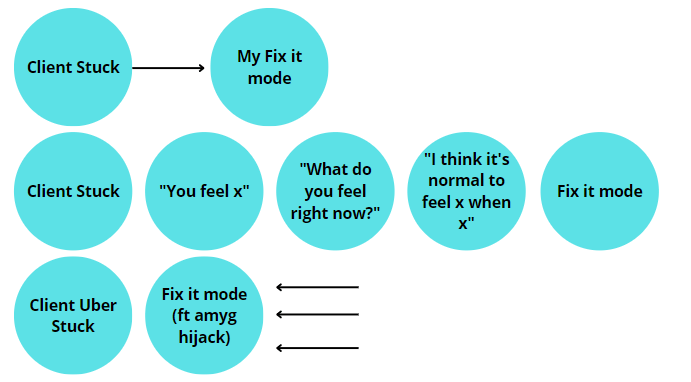
So what happened with my increase in confidence? I’ve had a number of client’s appear stuck over the last week, but in a moment of bravery I have responded exactly the way I want to. I have focused on observing the client’s tightening body language and voice as they become stuck. I then observe my body tightening, push back into my chair, to ground myself and acknowledge to keep observing the client. I’ll then say something like “I’m sensing some hesitation to using this idea?”, this gives them the opportunity to express their hesitation, but it can also cause them to struggle more and sink deeper into their emotional quicksand of stuckness. Normally seeing a client sink deeper would get me into “ok, NOW, fix it” mode, but now this is rare, I instead ground myself by pushing into my chair again and say something along the lines of “I’m noticing that my mind is pulling into trying to problem solve this for you”. I’m of proud of myself for taking the courage to be vulnerable, but it also gives myself and these client’s the opportunity to normalise and observe the unintended cost of the problem solving brain – my amygdala’s attempt at a hijack becomes a lesson, not a curse to be feared. These client’s and I realise that our minds were trying to do the same thing – problem solve an anxious thought. We both in that moment start to relax and allow ourselves to float above the emotional quicksand.
I still allow myself to be more directive with client’s who are very distressed, but calling out my “fix it mode” has helped erode at the belief that I need to solve that client’s distress right then and now.
While I may not yet have all the pieces to catching my “fix it mode”, I now feel a great sense of accomplishment and relief. I have finally turned the corner on an automatic behaviour and shifted it to something that is much more therapeutically engaging and powerful. Could I have done it without Deliberate Practice? Couldn’t I have have just gone straight into a course on Emotion Focused Therapy (EFT)? … Maybe, but I don’t think going straight into an EFT course would have helped me pick up my subtle and idiosyncratic “fix it mode”, because it was in my blind spot – deliberate practice has helped me see into my blind spot.
I mean look at what I’ve had to do, I’ve essentially done a behavioural chain analysis on my “fix it” mode, to look at the before and after of the behaviour, then with the help of an awesome coach (Nathan Castle) came up with new, small behaviours; repeating them over and over again in order to break up my “fix it” mode chain. It was tough, there were numerous points where I couldn’t see myself breaking the chain, but I kept at it and at it and at it – and god damn does it feel rewarding when you start to break free.
It feels incredibly empowering to know that supervision and learning new therapy techniques are not my only options to improving my professional skills, that my professional success won’t come down to how well I spend my career consuming therapy techniques. I’ll have better chances of success if I simply focus on the foundations of good therapy. I now know that I can follow this deliberate practice system I have created for myself, I’ve forged my own path to growth with the help of some amazing people. On this path I have found not only the therapist, but also the person I want to be. So dear reader, I hope my journey inspires you to do the same, to see that you too can forge your own path to growth and become what you value most.
 Deliberate Practice Psych