
All through this year I have tried to be guided by a central principle – aligning myself with what my client wants. Being on the same page for who they want to become as a person (outcome goals), how they want to get there (process goals) while re-acting effectively to their feedback. I have spent an immense amount of time trying to understand how I could align better, focusing on what I needed to do differently. My last post centred around just that, how through my coaching sessions with Daryl Chow, I have ended up using a system that allows me to align with a client’s desired process goal at each session.
I have spent hours turning inwards to deepen my understanding of my fears and how they could, at times, lead me away from where a client wanted to go. I’ve learnt that my brain, as a human brain; has limitations, biases and fears that requires systems to be managed. These systems mean that I don’t leave aligning with my client’s wants to chance, but instead I have a series of mechanisms in place to keep me aligned – which I am starting to call my Deliberate Practice Ecosystem.
I have learnt that aligning with clients on how they want therapy to work is a fantastic way to reduce friction between myself and them. When I put my own judgements on what needs to happen to the side, I demonstrate that therapy isn’t just about them trusting me, but me trusting them. I want my clients to feel treated as an adult, that they are capable of making their own decisions.
I think it’s fair to hypothesise that I have been reasonably successful in aligning with my clients and creating a more engaging therapy environment. In April this year I was averaging 11.7 sessions with my active clients, now I’m averaging 16.4 sessions with active clients.
As I became better at aligning with my client’s wants, I started to get a nagging feeling that in order to become more effective, I needed to go deeper.
Deeper meant helping client’s to get under the surface, to what they need to work on, in order to truly heal. For some clients, they want to avoid those deeper, more painful experiences and fears; whether it’s something like past trauma or negative core beliefs.
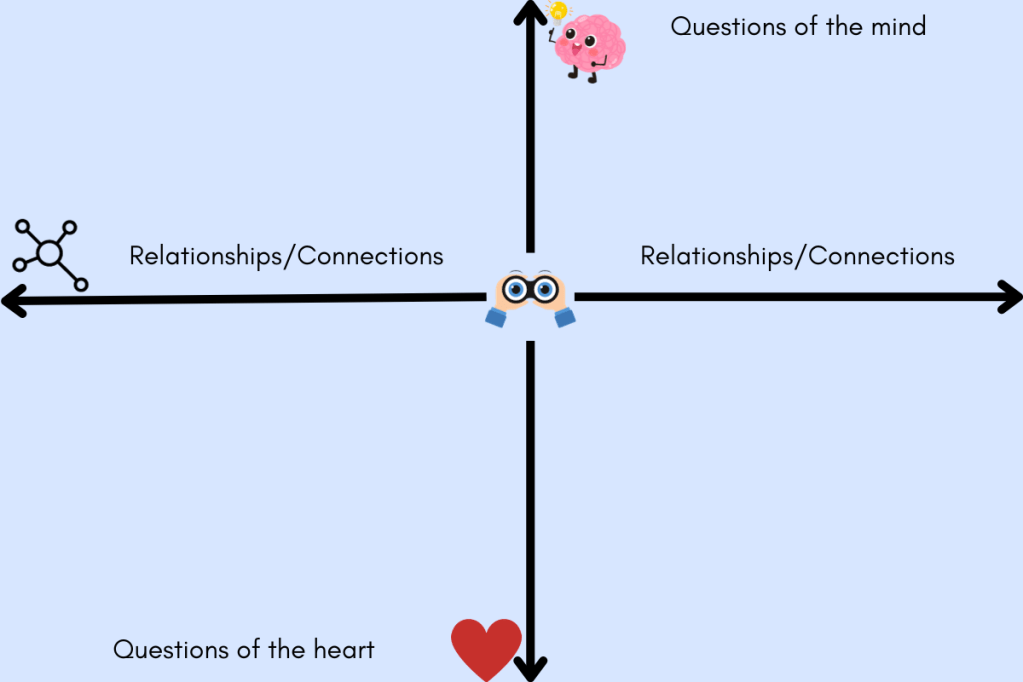
To help me go deeper I have been playing around with a framework, which you can see above. The framework illustrates the kinds of questions I ask clients, in an effort to help deeper healing. The binoculars represents my attention, which can move along the framework, like using the joystick in a video game (an analogy which is thanks to Daryl). The different directions embody different kinds of questions I asked clients.
Using the framework, moving my attention from side to side means I’m focusing on the relationships/connections between at least two different things. e.g. the client’s current self versus their past self. Moving my attention upwards means I’m focusing on getting client’s to use their analysing and rationale mind e.g. asking them about what triggers their anxiety. Moving my attention downwards means focusing on getting client’s to access their heart, including their emotions, e.g. asking them what or who they cherish most.
As it generally goes, using frameworks like this help me build courage to go into challenging spaces. I start to feel more confident in helping clients turn towards and follow their pain.

As I began to use this framework, I started with helping client’s turn towards their heart in order to heal. This meant I started to focus on asking them questions that were intended to be moving and heartfelt. Not only did reflecting on this framework help me to ask deeper questions, it’s also given me confidence to more often say to a client when I feel like they might be avoiding their pain. When I share these observations, a space is created where a client can observe what they are avoiding and why – maybe they are avoiding a deeper fear of embarrassment, because it feels overwhelming.
Asking emotive questions can be useful for clients who need to connect with their heart and feelings, in order to heal, those people who try their best to keep away from unwanted emotions because they are painful. This might be a client avoiding feeling the grief of past heartache.

Thanks to an observation from Daryl, he helped me realise that not all clients need to connect with their heart in order to heal. Some clients are not avoiding their emotions, because instead they might be feeling stuck in them or overwhelmed by them. They need therapy that will help them out of emotion, not into it. These clients might need a more cognitive approach that helps them connect with their soothing brain; to reframe or see a bigger picture beyond their emotions. This tends to be suited for clients who are experiencing things like panic or social anxiety, where understanding how their anxiety works can be very beneficial for them.

I started to appreciate again that not all clients need the same thing in order to heal, but this also made the picture more complicated. Knowing which direction a client needed to go within my framework isn’t exactly clear – I can’t know for sure.
In these situations, where therapy can head into different directions or styles I have trained myself to ask clients what their preferences are – this was my system for finding a direction. While clients may know where they want to go, far fewer of them know where they need to go. In that situation, my usual system doesn’t work – client’s can’t give me an answer.
The idea of not being able to lean on client preference started to fill me with uncertainty, which fuelled doubt that ended up in a state of dread. How was I going to get myself out of this one? If a client doesn’t know where they need to go in order to heal, who am I to say? I’m not an oracle. I started to convince myself that I didn’t have any idea at all where my client’s needed to go.
“Hold up.” – I eventually said to myself.
I’m just going around and around in this uncertainty. So I decided to do something about it. I came to the decision that I would review my active caseload, all 72 clients and see if I could give myself an idea on where they needed to go to heal, by using my framework. Did they need to move towards their heart or towards their rational brain?
In taking the time to sit down and run through that exercise I found that I had an idea of where clients needed to go for all but approximately 4-5 clients. That’s not too bad! It also brought me back to the realisation that it’s ok to trust my gut, while I can’t know the answer, I can at least have an idea. Then I remembered that all I need to test an idea is to lean on trial and error. If I don’t know where a client needs to go in my framework, just try a direction and if it doesn’t work, try another direction – it’s simple.
Now I’m feeling better, remembering to lean on trial and error has now saved me for the millionth time.
For some of those client’s where I was not sure on what they needed, I decided to have a conversation with them about it. I expressed my doubts to them which helped us agree on a course of action that would help them move towards their pain – whether that was using their head or their heart.
This framework I have shared is by no means perfect and I don’t expect it ever to be. It has now become another part of my Deliberate Practice Ecosystem (which I will one day share in full with an illustration). In my latest coaching session with Daryl, last Tuesday, I shared with him the same story I have shared with you today. His first piece of feedback from then has stuck with me, that it’s not just important to have an idea on where to go, but to have a rationale for going there that is known and clear to the client. It’s all well and good to help a client head towards their heart, but why should they go there?
I’m already thinking of ways I could refine my framework and Deliberate Practice Ecosystem to make a rationale clear. It’s rare that my mind can focus on one thing though, so I’m also considering how I can strengthen my ability to observe/connect with a client as a way of deepening my understanding of their experience. It’ll be interesting to see where things unfold next, so stay tuned to find out.
 Deliberate Practice Psych