
I’m sure we all know by now that Deliberate Practice, especially when applying it to your foundational skills, isn’t easy. Whether it’s finding the capacity to do it, figuring out what to focus on or learning how to do it effectively. Some of these challenges I have been able to resolve over time, but there a certain challenges that continue to be difficult, ones that may I never fully resolve. One of these that make Deliberate Practice hard is how often you have to find a sweet spot between two opposing modes of being, when working as a therapist – dichotomies you have to counterbalance. Here are some of what I mean:
- You have to be flexible but be structured at the same time.
- You have to allow yourself listen but do more than listen – we have to provide strategies (at least eventually).
- You have to be client led but provide just enough scaffold/direction at the same time.
- You have to encourage the client of their comfort zone without causing harm at the same time.
- You have to be prepared but calm at the same time.
- You have to be be vulnerable with self disclosure but also avoid counter transference at the same time.
- You have to be confident externally but not internally.
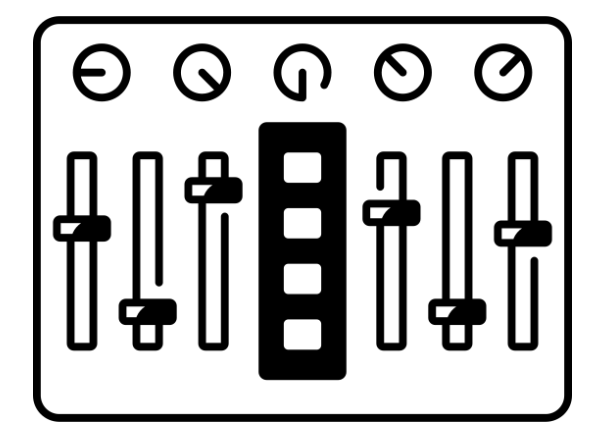
The dichotomy of states listed above act like sliders on a sound mixer, each individual client will respond differently to a particular calibration of these dichotomies. Not all clients like the same counterbalance. This makes our job all the more challenging. It can be tiring, but I’m also addicted to the challenge of responding to each client differently and well. As a small example, some clients will respond well to self disclosure from a therapist, others not so much.
The counterbalance between these states can be immensely difficult to maintain. It’s made no easier by the fact they are not tangible physical things with a finite number of confounding variables e.g. bass in music is well defined. The dichotomies I refer to are abstract and subjective experiences that have a potentially infinite number of confounding variables. To make it even harder, these states are also surprisingly difficult to define. People will often disagree on their definition. What does it mean to be truly calm? What does that look like externally and internally? It’s hard to know if I’m being something if I can’t quite describe it.
We also have our own preferences and biases like anyone else, like where others love country music, I really dislike it. Just because we’re therapists doesn’t mean we are immune to such biases. I’ve heard plenty of examples, like some therapists who prefer a more emotions focused response will feel completely dumbfounded that any other therapist these days would prefer cognitive or behavioural approaches – as if those are a form of blasphemy. My favourite is when we call each other unethical just because we don’t like what another therapist is doing…
I’m starting to consider if a truly consistent counterbalance between dichotomies is not possible, especially because the sweet spot of counterbalance will vary from client to client. For example, for one client I might have to be immensely calm to help them engage with session content, but for a second client I might have to mimic and match their excitability to engage them. If I was too calm for the second client, they might feel like I’m disinterested or not invested. My point is to state the obvious, that what works for one client doesn’t work another. I raise this because I think some therapists may be resolving the tiring nature of having to respond differently to each client by finding a default calibration of counterbalance between these dichotomies and then not straying too far from those default settings. I have considering though if this might be worth me pursuing as well. The obvious risk there though is that there will be some clients who do not respond well to those default settings.
There’s another layer of challenge again, where even if I did choose a preferred default state, my brain has its own desired default already in mind – which is different to what I would choose. Something I have to respect, because I am my brain.
I’ll explain it this way – my brain can be very divergent in its thinking. You might notice this easily if I ever talk to you about therapy in person for long enough, because if you ask me a question, I’ll likely give you four answers instead of one. I can also get into these impassioned and even excitable states when talking about therapy. I can easily get into such a state of flow that I’ll just talk and talk – like some sort of emboldened expounding. It’s quite a sight once I get going (my current DP coach has witnessed it often), but I often have to contain it because if I don’t I’ll just bulldoze through the other person – they’ll never get a word in. Containing it though can be tricky – it builds up a literal feeling of pressure in my head the more I try and contain it, the worse it gets, even to the point of headaches, as you likely know by now. So when I do let myself expound I often get a sense of relief and a good dopamine hit. I can even feel it right now, writing this post – that mix of excitement, adrenaline and anxiety. I have to keep pulling my hands away from the keyboard to stretch and contain the feeling. To make matters even trickier, most clients either like it when I do this, find it helpful, impactful or beneficial to them. I have asked clients if it was ‘too much’ when I get into such a state and they said it was totally fine, some of them even try to validate me when I get too apologetic for it – it’s almost like they are trying to reassure me that I can be myself. It only seems to become an issue if I stop listening effectively. It’s a really big thing and one of the reasons my over-explaining doesn’t just occur when I have a fear of not being helpful. I think what I’m trying to say is that it seems possible that my over-explaining (something I have written about for so long), is just a part of how my brain works – it’s a part of me.
Ok, I started to drift from my intended point. I decided to describe my divergent thinking because Daryl Chow (my current DP coach) often positions himself to help contain my divergent thinking – something that happens with kindness, patience and a genuine desire to understand me and how I operate. He maintains a scaffold and calmness that encourages me to counterbalance myself with a more convergent style of thinking. It’s very helpful, it keeps me grounded just enough and helps me land on the true core point of what I’m trying to say with all my emboldened expounding. Daryl’s calmness is consistent. I do appreciate this a lot, but there’s sometimes a part of me that just wants Daryl to shift that counterbalance and match my impassioned tone.
Which brings me to my sessions with my previous DP coach, Nathan Castle. Nathan would often get almost just as excited about my ideas, he would often match my tone, while not being so agreeable that there was no scaffolding or feedback whatsoever. Daryl and Nathan counterbalance their calmness at different points of the sound mixer scale. I don’t think one is better than the other, they are just different. Where Daryl more observes my thinking, it feels more like Nathan would experience my thinking with me. The two different styles would also have different benefits and unintended costs. One one hand, with Nathan I would feel less guilty about my expounding but would be less likely to land on a core point/takeaway that felt absolutely bang on target. Whereas with Daryl I can more of an undertone of guilt for my emboldened expounding (I have apologies to him at least once for doing it), but we are more likely to land on a core point/takeaway that feels absolutely bang on target. The frustration though, is that these two coaching styles scratch a different itch and a good part of me therefore wants to experience both at the same time – which I know is unrealistic.
Once again, I’ve gone a bit off topic towards the end of a blog post from where I started, but maybe there’s a point to my mental drift. Maybe the true point here is that I’m expecting myself to be everything for my clients. Maybe I’m expecting myself to adequately counterbalance all the above dichotomies of being, in different ways for different clients? If so – is that asking too much of myself?
Maybe it’s about allowing a certain level flexibility to find the right counterbalance with a given client, while still having a default counterbalance calibration to keep me anchored? Essentially, that I have a default way of being that I don’t drift too far from.
I ask these questions because it seems possible that my excited, impassioned expounding is a counterbalance to calmness, while also hard-wired in my brain. Does it mean that I’ll struggle to achieve true calmness in therapy? Because I can’t change my brain and how excited it can get about therapy. Nor would I want to. I quite like my brains ability to be so divergent and in depth. I know it’s a pretty cool ability and strength that not everyone would share. I do treasure it, even if it means I may not be able to connect with every single client that comes through my door because of it.
I’m not sure. I often try to come to conclusion or answer by then end of these posts, but I don’t think I have one here. I’m ok with that though. I’ll just have to keep thinking about it and see where it takes me. Wish me luck.
Sidenote: This post isn’t even that long but has taken me ages to write. The post really got my divergent thinking going, I kept having to pause and ground myself. It seems like my brain doesn’t like not having an answer!
 Deliberate Practice Psych
One response to “Counterbalancing”
[…] This is a continuation of thoughts I had on my neurodivergent thinking. I think things are finally starting to come together. I have been writing recently about how I have noticed that my over-explaining doesn’t just occur when I’m scared of not being helpful (variant 1), but also when I’m talking about a special interest (variant 2). These days those special interests seem to be neurodivergence (especially unmasking it) and values (in the context of ACT therapy). […]
LikeLike