
I’m at the begin of a new transition. I’ve decided that my Deliberate Practice coaching session with Nathan Castle today will be my last, at least for the time being. I concluded that I want to spend more time to master unhooking from my ‘fix it mode’, as was the focus in my previous post.
I see each of my blog posts as a progression of the previous one. Every now and then I have an aha moment where my conceptualisation of how I’m working on myself becomes just a little clearer, gaining more clarity just like I would each time the optometrist changes the lens at an eye test . The idea then behind each of my posts to see if I can explain with a little more clarity what I’m working on, because the better I get at explaining it, the better I get at understanding myself. I want to share my most recent aha moment that arose when thinking about what makes good therapy.

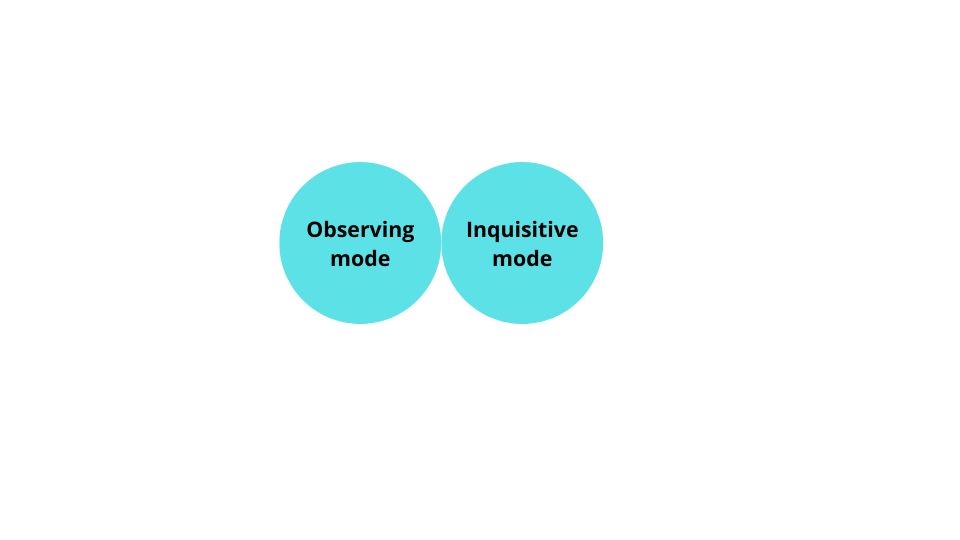
This first illustration above refers to how I use my observing mode to discern what problems a client is facing and what I need to teach them for those problems to get better. Sounds easy enough – however research is demonstrating that my ability to be able to just tell what a client needs through observation alone isn’t as good as I think it is. This research suggests that using observing mode alone too often results in leads the therapy in a direction that clients see as irrelevant or corners them into trying to do something they don’t see as possible.
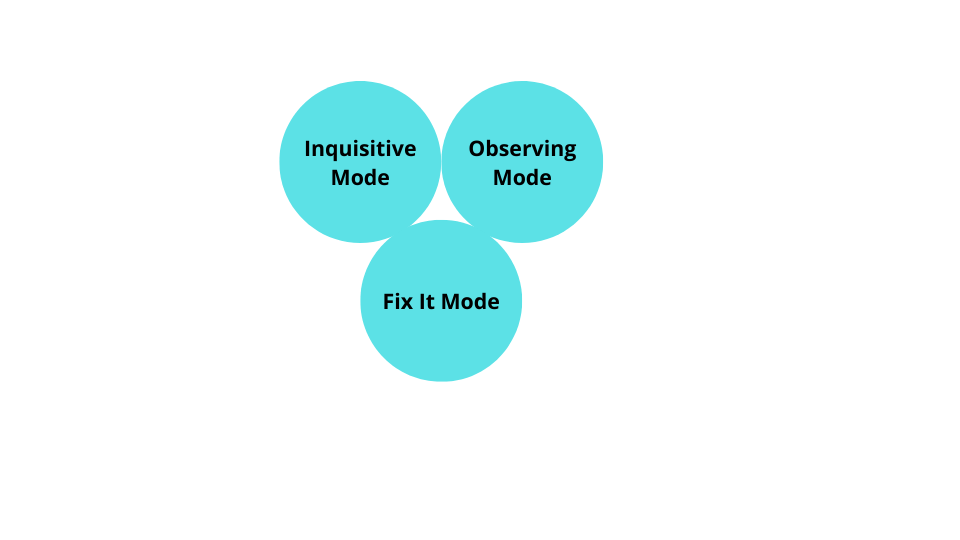
This takes us to illustration number two, which now includes what I’m calling my inquisitive mode, this is the part of me that asks questions with curiosity in the endeavour of learning more. It helps me understand if what I’m observing about the client is correct or not. Research is also demonstrating that using this inquisitive mode is useful to ‘attune’ with the client and get on the same page, therefore increasing their buy in. The client now feels more included and understood in their therapy – yay! Sounds easy enough, right?
Unfortunately though keeping my observing and inquisitive modes engaged in the right way isn’t always easy. Why? Well because of my stone age brain (amgydala), as when client’s are stuck it wants to jump in and save the day with fix it mode – which is the part of me that just wants to immediately fix the client’s problems, my amygdala sees the other two modes as inefficient a waste of precious time. This is a very automatic behaviour that is just trying to protect the safety of myself and the client, while understandable, it is not always helpful.
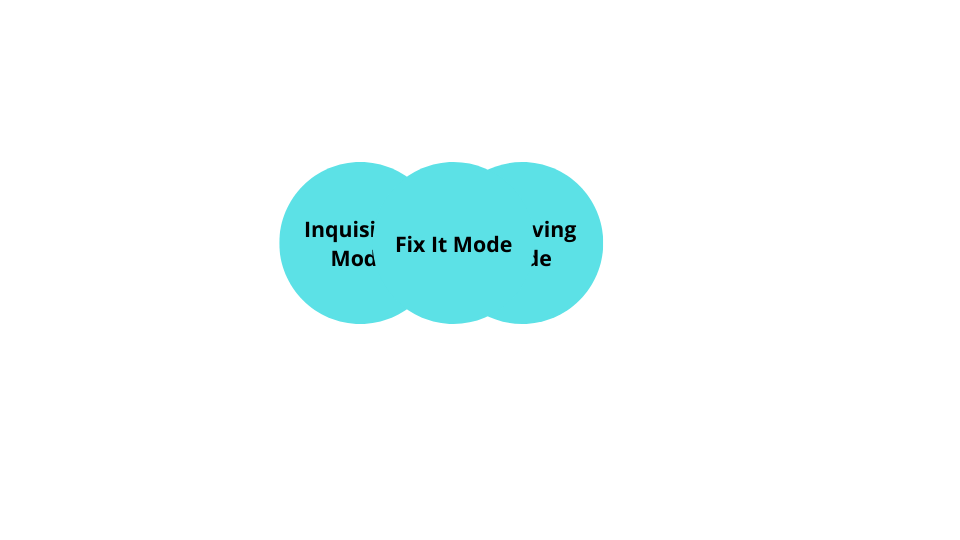

Fix it mode would sometimes completely override my observing and inquisitive modes. That’s now how I wanted to be, I want to be able to use keep using my inquisitive mode to encourage client’s to use their own observing mode to help them make room for their challenging thoughts and emotions.
At the start of my Deliberate Practice journey, I made attempts to get better at using my inquisitive mode to forge a stronger connection with the client and what they wanted to work. I then started to become aware of my fix it mode and brought in new skills to also include my observing mode, to get better at asking clients about their emotional experience. This approach only helped to a degree, while I got better at connecting with clients, my fix it mode didn’t really shift.
My more recent efforts then switched gears to use my observing mode in a different way – to take my observing spotlight and aim it at myself, instead of the client. I have become stronger at noticing when I’m getting into fix it mode, which is then a signal to ground and reset myself. It’s working well so far – I haven’t experienced an amygdala hijack in a therapy session since my previous post. I know I need more time with it though, while I’m best at catching fix it mode when I’m sitting in my therapy chair, I’m not as effective at catching it when I’m at my computer chair, standing up or in the midst of psychoeducation.
I think we all have our on version of an automatic behaviour that we perhaps don’t notice so well, that silently holds us back from being more effective therapists. For some it may be that the fix it mode resonates with you as well, for others it may be something entirely different. As an example I have noticed a few therapists engage in an automatic behaviour of blaming the client when they are not improving, which is entirely understandable but doesn’t work too well.
So as I continue to focus my internal spotlight on mastering catching my fix it mode, I know my progress will start to slow down, as I focus on taking smaller steps. I want to take that opportunity to transition the theme of my blog posts to have a greater focus on sharing what I have learnt so far in experiencing Deliberate Practice, in the hopes it will help those that want to experience it for themselves take up the journey.
 Deliberate Practice Psych
One response to “Taking control of the spotlight”
[…] Dropping anchor in response to me going into my fix-it and over-explaining modes. […]
LikeLike