
I’ve done something a little different this time. Instead of making a post for each coaching session I had with Daryl, I opted to wait until we had a few catch ups before writing about how coaching was going. These days I spend longer focusing on the one growth edge, even months at a time. So I really wanted to stew before sharing my experiences with Daryl.
Jordan, your patience has paid off – here’s what I have experienced in being coached by Daryl Chow.
Working with Daryl has been different to coaching I had in the past with Nathan. They have fairly different styles.
Whereas Nathan excels with behavioural rehearsals, Daryl’s style is much more reflective and mental. With Nathan I felt like we were at the coal-face, essentially practicing therapy drills, similar to how a soccer player would practice passing. The rehearsals were more anxiety provoking, but also more exhilarating. I would come out of those coaching sessions with such a high. I could almost feel my growth happening in real-time, whether that was true or not. The experience was similar to how I would have felt at soccer or cricket training, back when I used to play.
When it comes to working with Daryl, it’s more a theoretical approach. Instead of playing the game, the approach is analytical, like we’re watching tape of how I do therapy. Imagine athletes in the video room with their coach, refining their strategies based on what they are watching.
I don’t feel as much like I’m being put through my paces as heavily. Working with Daryl is more like a slow burn. Change is happening, but it sneaks up on you. After these sessions I’d almost be disappointed. I think I became used to the high that I was previously used to in working with Nathan.
The thing is, while I initially didn’t feel it, my sessions with Daryl would plant a seed. It might be days, it might be weeks until that seed would emerge, but once it did it came with a full force.
So the journey begins
I’m not going to provide a session by session recap in detail, because too much has transpired. I just didn’t have the time to write a post about each coaching session. Instead I’m going to focus on sharing my key lessons in working with Daryl so far. The coaching sessions occurred about every two months between February and September so far.
I came into coaching having practiced my system of desired behaviours to mitigate my over-explaining tendencies. By the time I had started with Daryl, I had been been practicing the system long enough that I felt ready to switch gears, but I wasn’t exactly sure what to.
That’s where Daryl and I started, finding a direction for growth. We reviewed my client outcome statistics which I had collected in an excel sheet since May 2021. After we poured over the data no obvious patterns were emerging based on the numbers alone. Daryl suggested that I review my unsuccessful cases to look for patterns on why those clients ended therapy prematurely. He also wanted me to record a session with a client, so that we could review it for potential learning opportunities.
It took me an evening to review my unsuccessful cases, but a pattern did emerge. Out of all my unsuccessful cases, almost all didn’t have a consensus with me when it came to therapy goals. Either we didn’t get up to goal setting at all or I misread what (outcome goal) the client was looking to address and how (process goal).
I knew it was going to take a little while to figure out how to strengthen goal consensus, so I made the decision to see if I could improve the quality of feedback from clients in the meantime.
I had noticed that both now and in the past, every so often clients say: “I can’t tell you if this therapy is bad because I don’t know what good therapy is supposed to look like“. Bingo. I had my window of opportunity. They had nothing to compare to. Which was especially prevalent for clients that never had therapy before.
The reasoning was sound enough, how can you give adequate feedback on something where you have nothing to compare to?
In turns out that this issue around goal consensus was something I worked on in the background, as it wasn’t what Daryl and I consciously worked on, but the following lessons I learned helped me align with clients in an unexpected way.
Try to not try
We are now at the point of reviewing my recorded session with a client. Daryl had listened to it beforehand to note some observations. He provided a numbered scale that would be used to analyse the session in segments. The purpose of the scale is to measure the intensity of which the client is experiencing a transformative experience. The main observation here is that I partially lost the client in the final phase of the session, where I attempted to provide an intervention. I just didn’t quite hit the mark. I had disconnected with the client to intervene. I tried too hard to provide something instead of keeping with my clients experience.
“Try to not try” was what Daryl said to me. It was simple. I needed some time for those words to sink in. I know we passed around what those words meant, but it’s a bit of a haze now. I think I have a tricky time remembering because my fight vs flight brain at the time wasn’t convinced that trying less was the right way to go.
Analysing and performing at the same time is not a good combo. Just Play.
After reflecting on trying to not try, I became determined to analyse just how much I was trying in therapy sessions. In order to best do that, I became compelled with the idea of demonstrating to Daryl just how much mental work I was putting in when I was working with a client. I’m not exactly sure why I decided to take such a deep dive into my therapy process, but one thing I have learnt is that my Deliberate Practice runs smoothest when I just allow my mind to go where it wants to go.
So I did just that. I ran Daryl through my internal process during a typical session in pain-staking detail, which laid out just how much internal mental load I was putting myself under in sessions. I’ll spare the nitty gritty details here, but my process was essentially this:
- Figuring out the target focus of the session – whether we were focusing on managing distress coping tools or instead focusing on underlying factors (e.g. perfectionism).
- Formulating the clients presenting issues
- Unearthing the ‘core issue’
- Providing an intervention, tools or strategies
I demonstrated that process by running Daryl through a series of notes I had written using an iceberg analogy. I’m sharing the below to demonstrate what happened, I don’t expect you to be able to read it (my handwritten is a puzzle in of itself), but hopefully you get an idea of what it was like, by the way that is one page of five sets of notes…
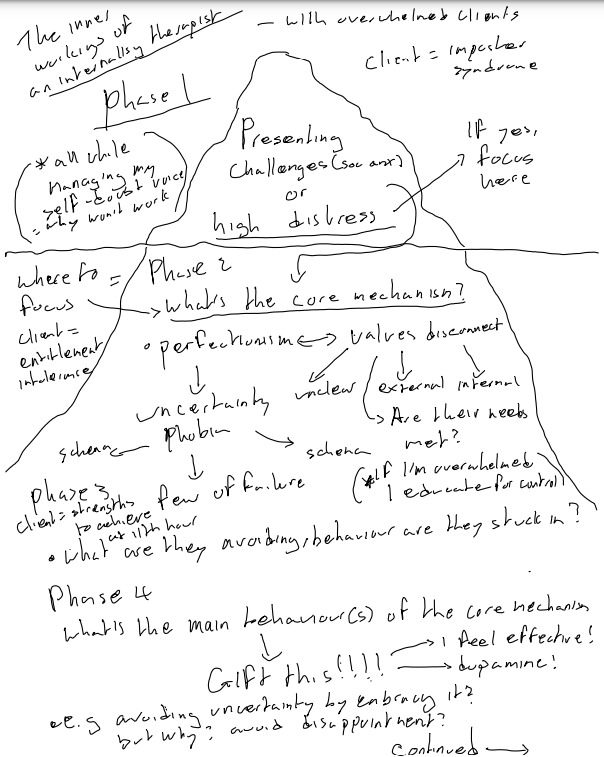
The lesson in response – I’m putting way too much effort into trying to analyse while also playing the game at the same time. It’s like if I was a soccer player, I’m trying to play the game while also having the play calling clipboard in my hands at the same time. That iceberg you have been likely trying to decipher was like my mental play calling clipboard.
Instead, I needed to just play. Leave the clipboard on the side-lines. You can analyse after the game is over.
Staying on the same page
Part of the magic of Daryl is that he gave me complete free reign in the sessions to go completely where I needed to go, he did his best to stay with my thread of thought along the way.

He kept on the same page as me, in doing so he kept me on the page. If went I up, he did too. If I went right, Daryl went right. You get the picture.
I had the space I felt like I needed, to just go where I wanted to go, while Daryl stepped back to hear out where I went. I was able to explore with someone else where I’ve wanted to go for a for long time, which was laying out the whole picture of how I do therapy. It’s like I just needed someone to really hear how I worked in order for me to move forward.
Everything came together
As I shared earlier, these lessons with Daryl didn’t cause an instant shift in me. I stewed on them over time. With each coaching session those lessons gradually combined to create something bigger – a new system. Trying to not try became allowing myself to stay connected with clients experience for as long as possible. Let the client’s experience lead the way. Let them go where they need to go. Don’t break away to lead the process unless absolutely necessary.
Eventually it hit me that all I really want is to be on the same page as my clients. In my mind, rightly or wrongly, if I’m on the same page as my clients, deeply and truly, I can’t lose.
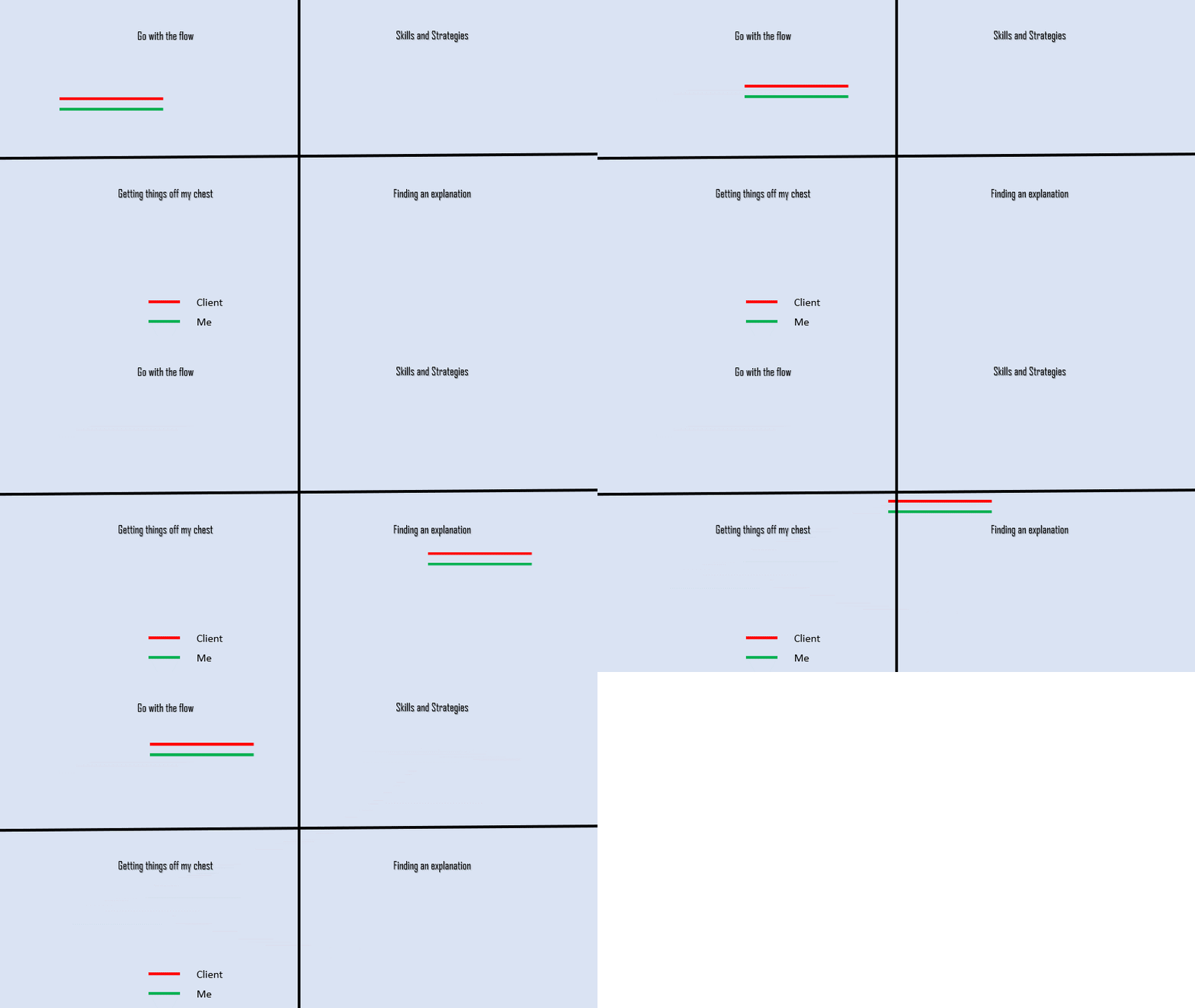
That’s where my focus has largely remained since, finding ways to stay on the same page as my clients. I have indeed formed a new system that involves checking in on what client’s would like to focus on at each session; whether it be getting things off their chest, finding an explanation for why they feel as they feel (formulating), developing tools/strategies or just going with the flow. Finding a focus with clients became my tool for goal consensus, in that this is now my way of aligning with a client’s process goal each session. Clients are then also able to assess and discuss with me how successful the session was at aligning with their process goal. This system also involves training myself to keep getting better at asking clients open ended questions, so they can keep showing me their experience instead of me trying to anticipate it, explain it or try to piece it together for them.
For now I’ll just leave this as a primer to sharing that system. I promise I’ll share it in more detail once I get to my 10th Deliberate Practice tip. In the meantime, you’ll just have to stay tuned.
 Deliberate Practice Psych
3 responses to “Keeping on the same page with Daryl Chow”
Thank you for a wonderful piece Jimmy. My brain is overflowing with thoughts on this one! I’m going to let me brain marinade and “do less” then see what settles. I think you’ve highlighted a key issue people want to know, what does DP with a coach look like? I suspect as time goes behavioural and mental processes will integrate well together in this space and become best of friends
LikeLiked by 1 person
Hey Nathan
Yep “doing less” is definitely a tricky one – I think for many of us. My process has basically turned into gradually fleshing out various systems to help me keep to doing less. Otherwise without these systems, if I just left it to my brain, it would want to keep doing more. So having systems in place is crucial, but they take some time to create and strengthen. I think behavioural and mental DP processes compliment each other well. Ideally incorporating both would be best, but I know float towards the cognitive more easily being often tight for time! (but that’s me).
LikeLike
[…] of time trying to understand how I could align better, focusing on what I needed to do differently. My last post centred around just that, how through my coaching sessions with Daryl Chow, I have ended up using a system that allows me to […]
LikeLike