
- Get Feedback From Your Clients
- Tailor your goal-setting approach to suit each individual client
- Use Routine Outcome Measurement
- Identify your automatic behaviours
- Address your most impactful automatic behaviour
- Identify a desired behaviour to replace your chosen automatic behaviour
There’s something that I was told repeatedly in my training to become a Psychologist. It was a line I heard time and time again. I know I’m not the only one that heard it…
“When you’re with a client, don’t bring your stuff into the room.”
Meaning don’t bring in things like your biases, negative core beliefs or anything that you have unresolved within you that could negatively impact the therapeutic process.
Does that make you uncomfortable?
Well if you’re with a client right now, it shouldn’t. Also, you probably shouldn’t be on your phone right now.
Hearing that phrase doesn’t make me uncomfortable anymore, instead, it makes me angry. Why? Because I think it’s crap. I’ve felt that more and more as time has gone on through my career.
To me that phrase is actually saying – “when you’re with a client, you should be able to switch off your fight vs flight brain completely. Because only clients are allowed to be human, you are a cyborg now. If a client sees your vulnerable human self, they will think you’re not a good therapist”.
I’m angry because through my training, I was backed into an impossible task, to try and switch off a part of my brain that is an integral part of my survival. It implies if I can’t turn off my fight vs flight brain, I’m going to be a crap therapist. So I better be confident and not doubt myself either.
The icing on the cake is that while we get told to switch off that unwanted side of us, we don’t get told how. Just that you should do it. No techniques, strategies or tools. I always found this so strange, as therapists sometimes we can give awful advice to each other, things that we would never say to a client.
I’m angry not just because I have been taught to by into an impossible task, but because the expectation that I must suppress myself has inadvertently taught me to go against what I preach. We teach our clients to acknowledge and work with their unwanted emotions and thoughts, not against them. Yet that’s not how my training taught me to react to my own.
If you cant tell already, I’m super passionate about this one. So much so that I highly recommend you bookmark this post, if it speaks to you, come back to it multiple times. This is the core of what my Deliberate Practice system addresses in helping me be a better therapist. It’s something I don’t think is super prevalent in Deliberate Practice content that’s already out in there in the world, even in my holiest of bibles, the book better results.
I think that needs to change. In my Deliberate Practice efforts, I have been teaching myself what I wish I learnt in my training as a therapist – to practice what I preach. Which is how to work with my fight vs flight brain not against it.
Now don’t get me wrong, I’m not saying to completely unleash yourself with clients. I’m not advocating for a world where we vent to clients for 10 minutes about our bad day, break into a fit of tears during a session or cast judgements with reckless abandon. It’s still important to recognise that if you’re not ok, it’s ok to get help. Seeing a doctor was always my first step when I was struggling.
My point is that there should be a lot more balanced in how we exist with our fight vs flight brain in sessions, because whether you want it to or not, it will come into the room.
If you’re someone that feels like they are able to keep their fight vs flight brain out of the therapy room. I’ll be honest, I’m going to have a really hard time believing you. If that is you though, I’d actually love to hear from you too, despite the fact I’m clearly not neutral in this debate. How do you keep your fight vs flight brain out of the room?
So how do we learn to exist with our fight vs flight brain?
Ok that’s enough of my rage against the machine.
Now lets get into what has helped me worked with my fight vs flight brain. These have been gradually formulated since I started Deliberate Practice in March 2021. These suggestions will go beyond understanding what you avoid and how you overcompensate in sessions, as I have written about previously. Addressing the fight vs flight brain is more than just knowing the behaviours it pulls us into.
Understand it
It becomes a lot easier to flow with your fight vs flight brain if you understand why it’s getting triggered in the first place. For me, once I understood, it felt easier to practice compassion and the urge to battle against my brain reduced.
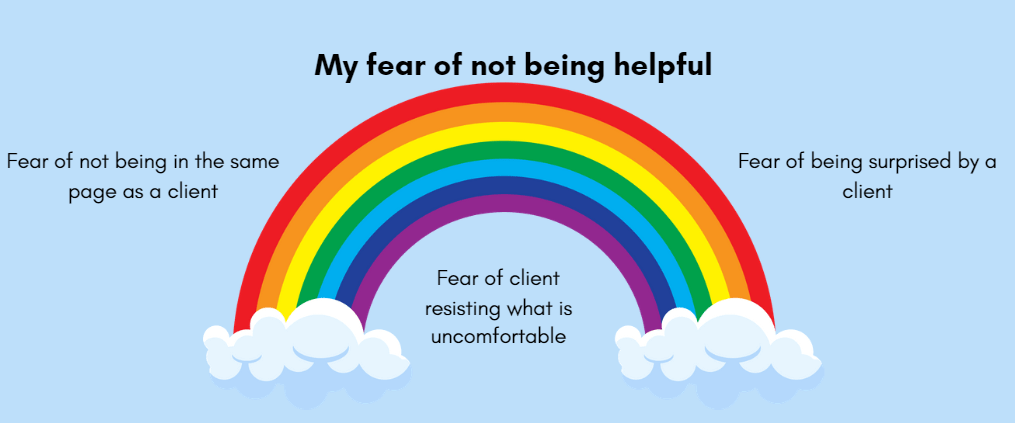
I’m referring at first understanding the core fear or belief that is the root of setting off your fight vs flight brain. Mine likes to fire off whenever it’s getting the impression (not necessarily accurately) that I’m not being helpful to my client. It has many, many perceived ‘warning signs’ that this is occurring, which essentially branch out into the following fears:
Firstly, a client resisting what is uncomfortable or ‘following the pain’ is a trigger that I have written about for a while, it’s probably the first thing I learnt my fight vs fight brain was reacting to. I’m gradually learning to gently encourage clients into these uncomfortable spaces by observing their experience and asking open ended questions, which of course is a work in progress that I’ll continue writing about.
Second, uncovering the fear of not being on the same page as my client, is something that has come fairly recently, through the time I have been coached by Daryl Chow. I’ve come to appreciate that some clients just want to get things off their chest, some want to find an explanation for why they feel how they feel, others may just want tools and strategies and the rest will just want to to with the flow of therapy naturally. In the past, not knowing which client preferred which pathway would send my brain into overdrive by trying to create space in the session for all four of those pathways to occur. I’ve since developed a system to help me ‘get on the same page’ as my client each session, which I’ll share at another time.
Third, I’ve come to realise that I’m also fearful of being surprised by what my client brings up. Realising this fear was very, very recent. Not even two weeks ago. I don’t necessarily mean things that are shocking or uncomfortable, but things that throw off the formulation that I have of the clients challenges, as it unfolds in my mind. A part of asking clients more open ended questions more often, is to allow them to show me what is going on for them. Doing so allows me to see their experience more deeply and accurately.
Know what it feels like
It’s important to learn what it looks like when your fight vs flight brain triggers in a session, going beyond the behaviours. What emotions come up? Is it dread, fear, anxiety, frustration, or something else?
Just as importantly, what physical reactions do those emotions bring? For me, I start to feel tighter in the chest and the urge to fidget with my hands and in my chair increases. I feel itchy. I mostly experience tension through my body though, especially across my head, but the main place it starts is I’ll get that classic ‘concentration face’.
It’s really important to understand what your fight vs flight response feels and looks like. If you don’t know, you then can’t respond to it effectively when it triggers. Don’t get pulled into the trap of pretending it doesn’t happen or have any impact on your sessions, if you do that, it’ll end up having more control then you realise. These lessons don’t just apply to our clients, this is a time where it’s important to practice what you preach.
Observe it
Learn to respect it, it’s trying to help you, after all
When I respect my fight vs flight brain, I’m not fighting with it. Because it brings all these unwanted feelings and behaviours, it would be really easy to get frustrated with it – and sometimes I do. It’s important though that I don’t let the frustration turn into seeing it as a burden I want to supress. I know that if I do that, I will only make it louder. Despite being aware of this, I still had to learn this lesson the hard way. Originally when I discovered my over-explaining tendencies, I tried to respond by fighting against it, which only made it worse.
I had to switch up that narrative, I started to appreciate over time that if I wanted to work with my fight vs flight brain, I had to respect it. Respecting it meant that I had to appreciate that while my over-explaining could be annoying, at the end of the day it’s my fight vs flight brain trying to be helpful the only way it knows how. At least I know my fight vs flight brain is working!
Call it out and label it (in the moment)
Whether it’s an emotion or a reaction of hesitation. Commentate it. I’ve trained myself to say out loud when my fight vs flight brain is trying to take over in session. It might be that I’m feeling completely torn between two potential approaches, I’m wanting to avoid a difficult subject or I’m worried that the client will have a negative reaction to what I want to say. Saying out loud when I’m hesitating for these reasons allows me to practice being with vulnerability and models to clients that these unwanted reactions can appear, they exist and they don’t have to be avoided.
Give yourself permission to bail out if you’re going into a spin
Sometimes I start to tie myself into knots while getting caught up in what I’m saying, I’m using too many words, sounding too abstract or I’m trying to put an analogy into words before its fully formed in my mind. In these situations I can start to lose what I’m saying or I can see that my client is. This is where an eject button can come in handy. Whenever I notice that I’m no longer making sense, I stop myself, I acknowledge that I’ve talked myself into a corner – I literally say it out loud. I then let myself start again. Worst case scenario, in my 2nd attempt if I can’t make my point clear I’ll park it for later. This is essentially a reminder to myself it’s ok to not have a handle on something sometimes the best option is just to abort.
Have a laugh at it
It’s a small idea, but can be surprisingly effective. I sometimes use this as a bail out when I’m in the thick of over-explaining. I’ll essentially catch myself, stop and laugh at myself. Saying something like: “I’m sorry, my stone age brain is clearly trying too hard right now”.
Ground yourself
I have trained myself to catch in sessions when my face and body tightens. It’s thanks to my wife that I have started doing this, who first suggested I practice body scans in response to fight vs flight. It quickly turned into noticing my elbow when I got in the car in the morning and eventually evolved into something bigger.
I started to learn that I couldn’t ground myself effectively once I was deep into over-explaining, by then it was already too late. I needed something that caught this behaviour from the very start. One day I decided to try a technique I learned through ACT therapy, called dropping anchor. Dropping anchor falls into three steps:
- Acknowledging and observing – which meant internally calling out and noticing when my ‘concentration face’ starts to happen.
- Connecting with my body – I’d very lightly and subtly push my back into my chair, noticing the chair as best I could, while taking a moment to relax my face again.
- Re-engage with my environment – Next I would get back to observing the client, their facial expressions and body language.
I might have to drop anchor numerous times through a single session, but I don’t mind, so long as it helps me stay engaged and allows me to stay connected to what matters, which is the clients experience.
Show it the way gradually but repeatedly
These strategies allow me to show my fight vs flight brain that these threatening situations can be faced safely and that it doesn’t have to override me to protect me. It turns into a form of gradual repeated exposure, that occurs almost every session. The exposure slowly rewires my fight vs flight brain, reducing its intensity. It allows me to go where I need to go – that helping clients follow the pain is something to be pursued, not avoided.
Pass it on
If this post spoke to you to. Please save it, keep coming back to it, let the message sink in. Even better, share it around to anyone you think could benefit from hearing this message. That as therapists, it’s ok to be human, we are not cyborgs created in a university lab. I want this message to get out to as many people as possible, because my biggest realisation in my Deliberate Practice journey is that it’s essential I learn to work with my fight vs flight brain, not against it or pretend it’s not there. We just need to learn how; to learn what we were never taught. Please also don’t hesitate to reach out to me if you need help with what is a fairly tricky task – to let yourself be vulnerable. It can be done.

 Deliberate Practice Psych
One response to “DP TIP #7: Understand how your fight vs flight brain impacts your work”
[…] Understand how your fight vs flight brain impacts your work […]
LikeLike