
I believe strongly that in order to demonstrate what Deliberate Practice looks like and how it helps, it’s only fair for me to share my Deliberate Practice process. I know that you won’t be as willing to try Deliberate Practice for yourself if you don’t know what it looks like.
Sure, I have been sharing my journey, somewhat in pieces – I try my best to follow a flow, which I hope creates a sense of fluency to my posts. I didn’t just want to share my Deliberate Practice process in pieces, I wanted to eventually be able to show the whole puzzle in one complete form, preferably in a visual way. I’ve been holding off from doing this though because I could never find a satisfying way to encapsulate visually everything I use in Deliberate Practice.
That finally changed at the start of my holiday break in late December. A moment where I had that buzz of a realisation and I knew I had found exactly what I was looking for as soon as I saw it.
It was the last week of December and I wanted to wind down, which typically involves watching a documentary. I often enjoy learning how something is made or how a renowned master in their field got to the top of their respective mountain – doubly so if the story is about an athlete. I was poking around on my tv, looking for something to stream. I came across a series called Shohei Ohtani; Beyond The Dream. I didn’t know anything about this beforehand. I’ll give you the short version. It turns that that Shohei is a Japanese baseball player playing Major League Baseball. He’s at the peak of his career. He’s not just a run of the mill baseball player and they didn’t just make this show about him because he’s not American. They made it because he’s considered to be the modern day Babe Ruth (Ruth is considered possibly the best baseball player of all time). What makes Shohei stand out is that he’s practically the first player since Ruth to master being what’s called a ‘two-way’ player. Meaning that Shohei has mastered both the art of pitching a baseball and hitting.
I’m not into Baseball at all (Cricket is better), but apparently being a two way player is a massive deal. While that does sound impressive to me, as a non-fan, it’s not what stood out to me in this documentary.
The thunderbolt of inspiration hit me and I became glued to the tv when they shared a piece of paper that Shohei had drawn up when he was in high-school. I’m going to show you the English translated version below.
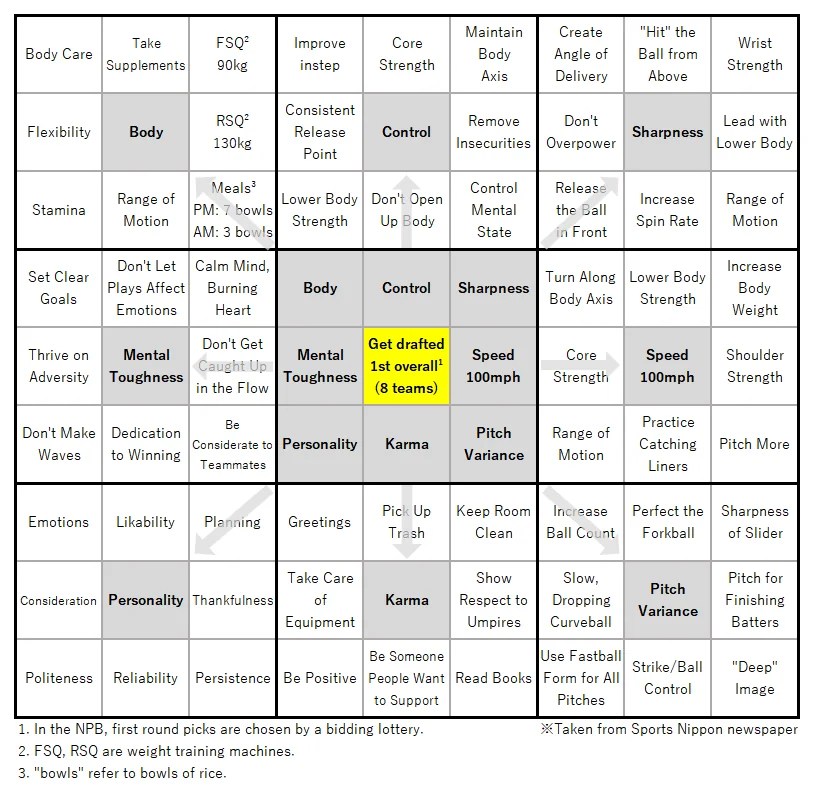
What you’re looking at are the goals that Shohei had written for himself in high-school. What drew me in was not only how young he was when he drew this up, but the level of structure and depth it contains in one image. In the middle is his main goal, surrounded by 8 sub-goals, with each sub-goal containing 8 smaller goals. He apparently just wrote what came to mind at the time. The thing is, this is more about principles than goals. Principles are exactly what I try to be guided by in my deliberate practice efforts.
So there it was, out of sheer luck that I stumbled on exactly what I had been looking for. After months of thinking and playing around I finally had a template to share my own Deliberate Practice process.
I quickly then got to writing my own version as what Shohei had done. I didn’t think about it too much, I was done after about an hour. I just wrote down what felt right. It contains the principles I most try to be guided by in my goal to becoming a more engaging and effective therapist.
Without further ado.
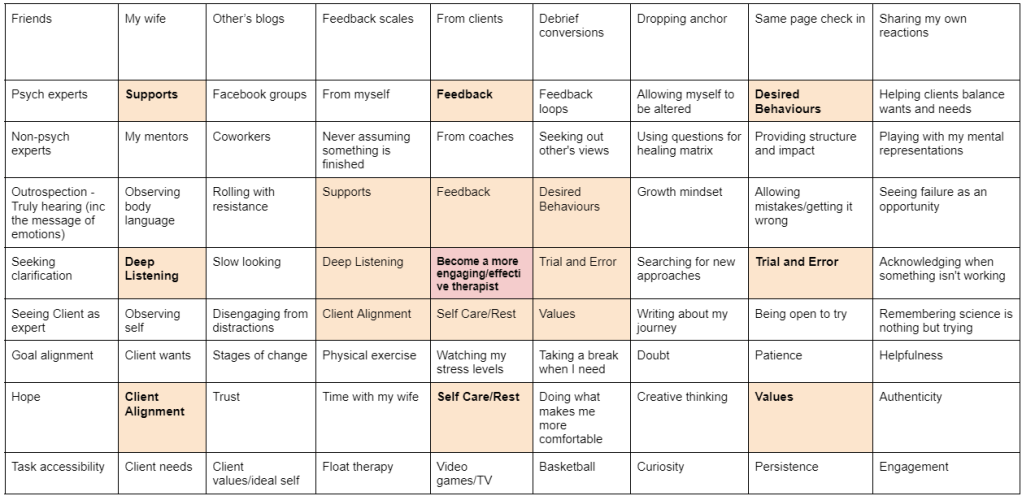
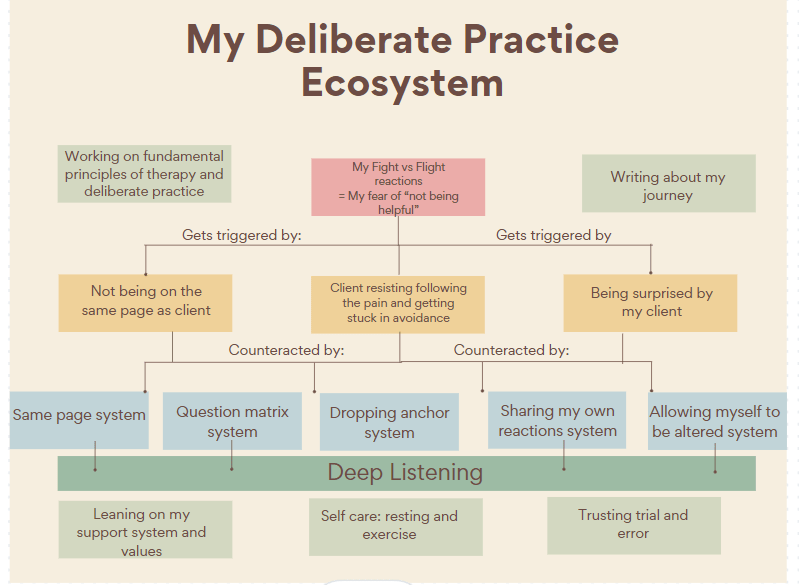
I’m calling it my Deliberate Practice Ecosystem Matrix. It’s essentially been developed over the last 3 years, slowly but surely, with much trial and error. It contains just about every underlying principle I try to focus on to be a better therapist along with a lot of the systems I have developed and used as part of my Deliberate Practice efforts. I plan to focus on this matrix as best as I can for 2024, especially the newer parts that centre around ‘deep listening‘.
It will likely continue to evolve as time goes on, I don’t see it as being set in stone, but I think it is a good start.
I also thought I would quickly share some of the earlier images I developed, the ones I wasn’t quite happy with, so that you get a feel for my ongoing process.
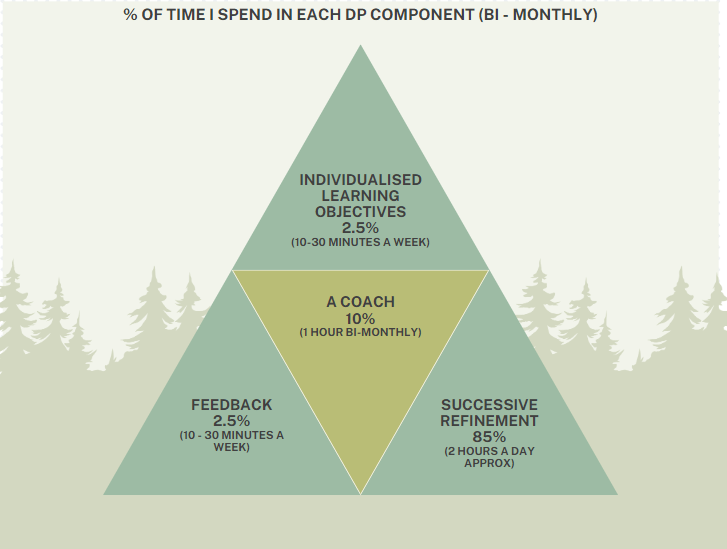
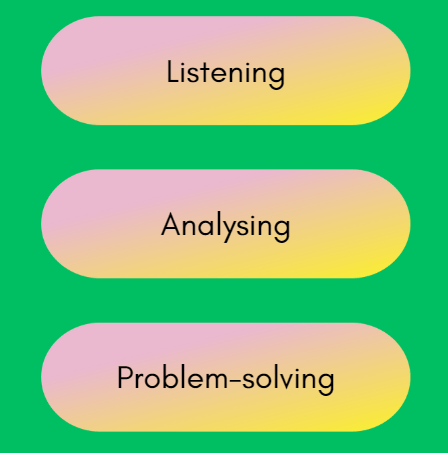
That will do it from me for now. I hope you all go well into 2024 and had an enjoyable holiday period. I may be a little quieter over the next month or so, as I plan to focus on studying for an exam, as the first part of becoming a psychologist supervisor. In saying that, I am planning on sharing my outcome statistics for 2023 by late February – so keep an eye out for that as I’m sure my stats will be an interesting read.
 Deliberate Practice Psych
2 responses to “I Finally Have A Visual For My Deliberate Practice Ecosystem”
[…] the course. I’ll focus this year mostly on consolidating and strengthening my engagement with my current Deliberate Practice Ecosystem as it stands, especially focusing on deep […]
LikeLike
[…] I could have kept going in sharing my examples, as in reality there are eight pillars of my current Deliberate Practice ecosystem, so eight sections of the wall. It didn’t feel useful to continue writing about all eight here, hopefully you get the idea though. If you want to see all eight pillars, you can see my previous blog post on them. […]
LikeLike